Accountable source ownership
Record the source, owner, classification, service, purpose and module scopes. Approval requires source text, an accountable owner and a review-by date.


Knowledge Studio governance and publication lifecycle
Control what the AI is allowed to retrieve, who is responsible for it and when it needs review. Knowledge Control describes the ownership, staging, approval and publication lifecycle implemented through Knowledge Studio and scoped retrieval.
Knowledge Control provides the shared governance lifecycle implemented through Knowledge Studio and scoped retrieval. Meridian Knowledge is the retrieval and answer experience; Knowledge Control is the lifecycle around the material it uses. A source can be imported and inspected without becoming approved for a caller-facing journey. Service, module, audience, effective-date and review-date metadata help determine when content is eligible.
Content owners, administrators, approvers and service governance teams who need to manage changes and inspect where published material is used. The current Studio decision routes use an administrator dependency; a separate enforced multi-person approval process should not be assumed.
Record the source, owner, classification, service, purpose and module scopes. Approval requires source text, an accountable owner and a review-by date.
Import or correct content into a staged state. Review duplicate and possible-conflict signals rather than treating every uploaded document as immediately usable knowledge.
Approve, reject, deprecate or restore an item. Approved content must be deprecated before editing, and a revision returns it to staging with a new version.
Apply eligibility rules before retrieval and inspect source/module relationships, review metadata and feedback signals. A visual graph is an inspection aid, not a new clinical inference engine.
Parse supported source text and map metadata; stage the candidate content.
Review ownership, duplicates, conflicts, module scope, audience and dates.
An authorised administrator approves, rejects or deprecates the item, recording the decision.
A permitted module requests eligible passages with source and version references.
Use feedback and review dates to revisit content; revisions return through staging.
A managed knowledge catalogue with lifecycle state, ownership, dates and version metadata; eligible passages with source references; and graph or review signals that help people maintain the collection. Uploaded content and approved content remain distinct states.
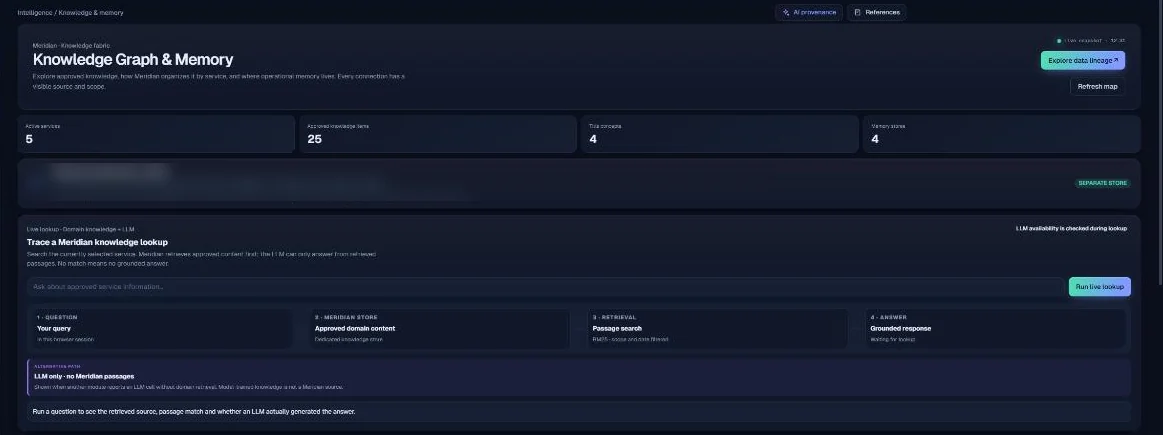
Knowledge Graph & Memory / Interactive concept map
Explore the concepts behind a conversation or decision, the sources that explain them, and the controls around their use. Select a node to reveal its relationships and follow the branching connections.
34 nodes · 60 relationships · 5 connected domains
Relationships describe an illustrative semantic model, not an execution sequence or a live inventory. This website example does not establish an implemented graph database or automatic concept extraction. Helpdesk article governance remains a separate workflow.
The explanation below describes the reviewed implementation and configuration boundaries. It does not assert a completed production deployment.
| Component | Technical mechanism | What to verify |
|---|---|---|
| Repository | The knowledge provider keeps a separate local SQLite file, or uses a configured Azure Tables namespace when cloud storage is selected. | Content is not stored in or trained into the LLM. A separate namespace is not an independent security boundary. |
| Import and normalisation | Knowledge Studio parses CSV/JSON source content and maps fields such as source, owner, service, dates, audience and module scopes. | Import validation is not a factual review of the source and does not establish permission to reuse copyrighted or personal content. |
| Decision endpoint | The reviewed item-decision route is administrator-protected and accepts approve, reject, deprecate and restore decisions. | Approval checks owner/source/text and review date, handles duplicate/conflict conditions and records actor/time. This is not automatically two-person separation of duties. |
| Version management | Editing approved content is blocked until deprecation. A revision increments the version and stages the item; restoring previous content also creates a staged version. | Restoration does not silently republish old content. It still requires the relevant lifecycle decision. |
| Eligibility gate | Studio retrieval filters status, module scope, voice eligibility where needed, audience, service and effective/review dates. | The legacy library has additional freshness rules, and undated legacy material can remain searchable with warnings. No universal same-policy claim is made. |
| Retrieval trace | The inspected Knowledge Fabric ranks eligible passages using local BM25 and returns source/version references, counts and llm_generation=false. | The retrieval step does not generate an assessment or modify a workflow. Optional downstream generation is separate. |
| Graph and feedback | An administrator-facing graph projects sources, module/service links and review metadata; feedback can flag content for review. | Suggested links and feedback are signals, not autonomous approval or automatic model learning. |
The reviewed product runtime exposes POST /api/knowledge-fabric/retrieve. An example request is shown below. This is a product API description, not a live endpoint on this marketing website.
{
  "module": "virtual_agent",
  "question": "When can I contact the service?",
  "k": 3
}
The response identifies the requested module, matching references and a retrieval trace. The inspected path sets llm_generation to false: finding a passage is a separate operation from asking a model to phrase an answer.
The eligibility checks run before ranking. An approved item still needs the right module, audience, service and dates. For voice retrieval it also needs voice eligibility. This is how content control influences what can be retrieved without training the content into a model.
Test rejection, deprecation, restoration, overdue dates, scope mismatch and a zero-result lookup. Review the actual role enforcement configuration. Helpdesk’s active-article mechanism is separate and does not automatically inherit Studio’s approval workflow. No content governance screen can by itself establish that all module data paths are controlled.
Meridian is a composed modular application. Customer-specific Azure resources, Entra configuration, routed storage and the shared AI gateway form part of the deployment design. Actual role coverage, data flows, provider regions, retention and recovery must be checked in the target environment.
The supplied source review identifies v23.1.0 Helpdesk Plus as its runtime baseline. It records incomplete targeted tests and no live Azure or Graph verification. Read the dated assurance summary before interpreting source capabilities as production readiness.
It is the shared control capability around the knowledge lifecycle, surfaced here with its own page. Meridian Knowledge remains the retrieval and answer product area.
Not in the described Studio workflow. New material is staged and needs the relevant decision and eligibility conditions before scoped retrieval.
The reviewed Helpdesk assistance uses its own active-article list. An active flag is not evidence of Knowledge Studio approval; harmonising them would need explicit implementation.
No. The inspected Fabric step returns reference passages and trace metadata without LLM generation or automatic assessment changes.
Based on the supplied design archive and local v23.1 source baseline. These references identify the reviewed implementation; they are not links to a publicly exposed code repository.