Passage retrieval
Split enabled, eligible articles into passages so a reference points to a specific part of a document rather than an unexplained whole-library answer.


Source-backed retrieval and inspectable answers
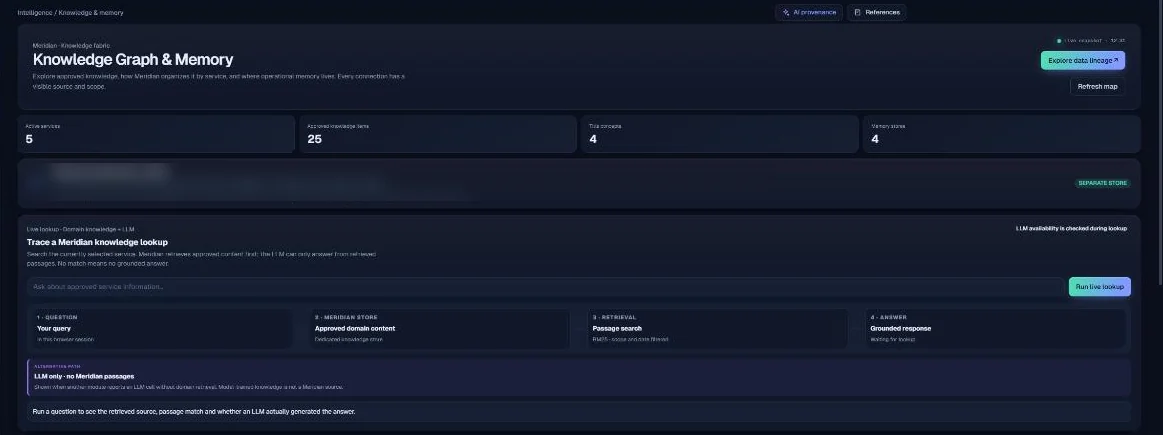
Find relevant passages, preserve their source and support an answer a person can inspect. Meridian Knowledge separates content storage and retrieval from the language model that may phrase a response.
Knowledge is the retrieval and answer experience used by configured Meridian journeys. It helps a handler or permitted module locate material relevant to a question, with references to the passages used. The underlying content remains in a Meridian-managed repository; importing knowledge does not train it into a language model. Knowledge Control is the management lifecycle that determines what can be published and where it may be used.
Service owners, handlers and product teams who need answers tied to identifiable sources. It also supports reference retrieval for scoped modules, with different audience and use boundaries.
Split enabled, eligible articles into passages so a reference points to a specific part of a document rather than an unexplained whole-library answer.
Returned passages carry article and passage identifiers, titles and source references. The Knowledge Fabric also exposes version and retrieval trace metadata.
The optional knowledge.answer model task receives retrieved passages and is asked for a structured answer with citations. A validation step checks the returned structure.
An empty match or rejected answer can remain unavailable. The implementation also has a bounded extractive fallback when the best local passage meets configured match thresholds.
A permitted journey supplies a question and a module or service context.
Apply the relevant content eligibility, audience, module and date rules.
Search passages and order the matching results.
Optionally ask the configured model to form a short answer from those passages.
Show source references and leave the next operational decision with the person or configured workflow.
Relevant excerpts, their sources, passage identifiers and, where that route supplies them, version and retrieval-trace information. An answer may include a citation-backed short response or an explicit absence of an acceptable answer.
Knowledge Graph & Memory / Interactive concept map
Explore the concepts behind a conversation or decision, the sources that explain them, and the controls around their use. Select a node to reveal its relationships and follow the branching connections.
34 nodes · 60 relationships · 5 connected domains
Relationships describe an illustrative semantic model, not an execution sequence or a live inventory. This website example does not establish an implemented graph database or automatic concept extraction. Helpdesk article governance remains a separate workflow.
The explanation below describes the reviewed implementation and configuration boundaries. It does not assert a completed production deployment.
| Component | Technical mechanism | What to verify |
|---|---|---|
| Local ranking | Local search tokenises article titles and passage text, then ranks matches using BM25 term-frequency and document-length weighting. | This is lexical retrieval. Do not describe the reviewed local implementation as an embedding-only vector search service. |
| Passage construction | The reviewed library groups roughly three sentences per passage and retains article/title/source identifiers. | Retrieval quality depends on source structure and the words used in the question; representative evaluation is necessary. |
| Optional search adapter | The legacy knowledge library has an optional Azure AI Search adapter when explicitly configured. | The Knowledge Fabric retrieval path inspected in this review uses local BM25; an optional adapter is not a universal cloud-search deployment. |
| Answer validation | The knowledge.answer path checks for citations to supplied passage IDs and requires numbers in the answer to appear in cited passage text. | These checks constrain output; they do not prove every statement is correct or remove the need for human review. |
| Knowledge Fabric | Module-scoped retrieval returns references and trace data, including candidate/matched counts and llm_generation=false for that retrieval step. | Retrieval itself does not change assessments, scores or workflow decisions. Optional downstream generation is a separate step. |
| Storage | The knowledge provider supports a separate local SQLite knowledge file or an Azure Tables namespace. | Logical separation does not establish an independent security boundary or an automatically provisioned vector database. |
Test missing knowledge, ambiguous wording, expired content, unsupported numbers and misleading sources. The Studio path and the legacy library apply related but distinct eligibility checks: undated legacy material can remain searchable with review warnings. Do not infer that all module articles inherit the full Knowledge Control lifecycle.
Meridian is a composed modular application. Customer-specific Azure resources, Entra configuration, routed storage and the shared AI gateway form part of the deployment design. Actual role coverage, data flows, provider regions, retention and recovery must be checked in the target environment.
The supplied source review identifies v23.1.0 Helpdesk Plus as its runtime baseline. It records incomplete targeted tests and no live Azure or Graph verification. Read the dated assurance summary before interpreting source capabilities as production readiness.
No. Content is stored in Meridian’s knowledge repository and retrieved at request time. Supplying excerpts to a model is different from training or fine-tuning.
No. It makes the source inspectable. The reviewer still needs to check applicability and whether the answer is actually supported.
Knowledge is the retrieval and answer experience. Knowledge Control describes the ownership, staging, decision and publication lifecycle around that content.
Based on the supplied design archive and local v23.1 source baseline. These references identify the reviewed implementation; they are not links to a publicly exposed code repository.