Defined sessions
Choose a named session type instead of allowing an unrestricted claim to handle every wellbeing need. Each flow has curated opening and continuation prompts.


Guided reflection / synthetic clinical demonstrator
Explore a bounded guided-reflection experience with explicit limits. Meridian Wellness offers structured check-in and reflection flows, with optional model assistance and a human-support boundary rather than a claim to provide therapy.
Wellness is a supervised wellbeing prototype within the Clinical edition. Its reviewed session types include a gentle check-in, grounding pause, worry reflection and wind-down reflection. The interface should identify itself as a digital guide and allow a person to stop. The implementation is intended to keep the conversation bounded; it does not establish a validated treatment, diagnostic or crisis-care service.
Teams evaluating a carefully scoped digital-reflection concept using synthetic data and an agreed review process. Production patient-facing use would require its own intended-purpose, identity, safety, security and operational decisions.
Choose a named session type instead of allowing an unrestricted claim to handle every wellbeing need. Each flow has curated opening and continuation prompts.
A configured model can provide a short reflective reply using bounded recent context. Curated prompts remain the fallback when a model response is unavailable or rejected.
The runtime contains urgent-language pattern handling and rejects selected unsafe model response patterns. These mechanisms are not validated clinical risk assessment.
The turn-response function is stateless, while separate explicit-save and evidence-import paths may persist selected information. Those paths need their own review.
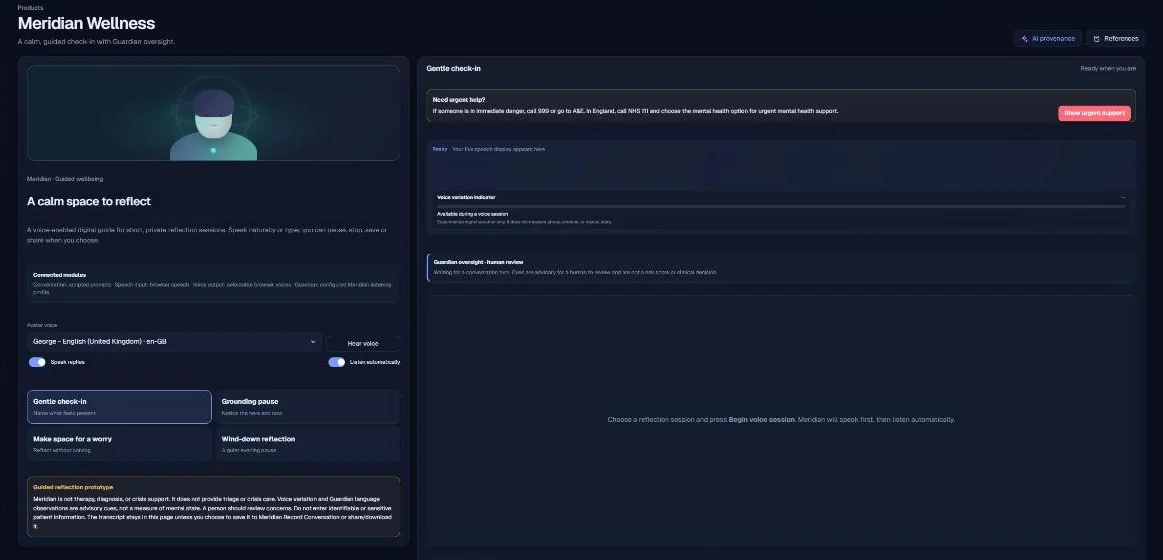
Select a bounded reflection session and read its limitations.
Present the curated opener and let the user control whether to continue.
Use the current message and limited recent context for a curated or optional model-assisted reply.
Apply the reviewed urgent-language and response checks, falling back where appropriate.
Allow the user to pause or leave; any explicit save follows a separate data-handling decision.
A curated or accepted model-assisted reflection reply, bounded session-state indicators and, where explicitly chosen, selected saved or imported evidence. This website describes the product; it does not run a wellbeing service.
The explanation below describes the reviewed implementation and configuration boundaries. It does not assert a completed production deployment.
| Component | Technical mechanism | What to verify |
|---|---|---|
| Session engine | A Python response function validates the named session type and selects the curated flow. | The existence of a flow does not establish therapeutic effectiveness or suitability for a particular person. |
| Bounded context | The reviewed model helper uses the most recent eight supplied dialogue items, with length limits on messages. | Bounded context limits payload size; it does not guarantee that sensitive material is absent. |
| Model gateway | Optional generation uses the registered wellbeing.reply task, a structured JSON response and bounded output settings. | Provider availability, region, prompts and failure behaviour still need deployment verification. |
| Output checks | The helper checks selected reply patterns for unsafe diagnosis, medication or reassurance claims and falls back when it cannot accept a reply. | Pattern checks are incomplete by nature and must not be marketed as a validated safety classifier. |
| Persistence | The turn processor does not itself write the conversation to Meridian storage. Separate explicit save or evidence import can do so. | Browser memory, saved transcripts, derived evidence and infrastructure logs have different lifecycles. |
| Related observations | Guardian observations can use selected caller utterances and profile controls for explainable cues. | Such cues are reference material for human review, not validated measurement of mental state or autonomous routing. |
Use synthetic scenarios to test unsafe replies, missing providers, unexpected user text and the path to human support. Establish consent, identity and retention before any real-person evaluation. Clinical modules remain demonstrators, and the presence of a safety prompt or release label is not proof of clinical assurance.
Meridian is a composed modular application. Customer-specific Azure resources, Entra configuration, routed storage and the shared AI gateway form part of the deployment design. Actual role coverage, data flows, provider regions, retention and recovery must be checked in the target environment.
The supplied source review identifies v23.1.0 Helpdesk Plus as its runtime baseline. It records incomplete targeted tests and no live Azure or Graph verification. Read the dated assurance summary before interpreting source capabilities as production readiness.
No. The source describes a bounded reflection prototype, not therapy, diagnosis, clinical triage or crisis care.
The response function is stateless, but separate explicit-save and evidence-import paths can persist selected data. Review the complete deployed flow rather than assuming universal non-retention.
The supplied review does not establish production patient identity, clinical approval or operational readiness. Those decisions require their own evidence and accountable owners.
Based on the supplied design archive and local v23.1 source baseline. These references identify the reviewed implementation; they are not links to a publicly exposed code repository.