Scripted capture
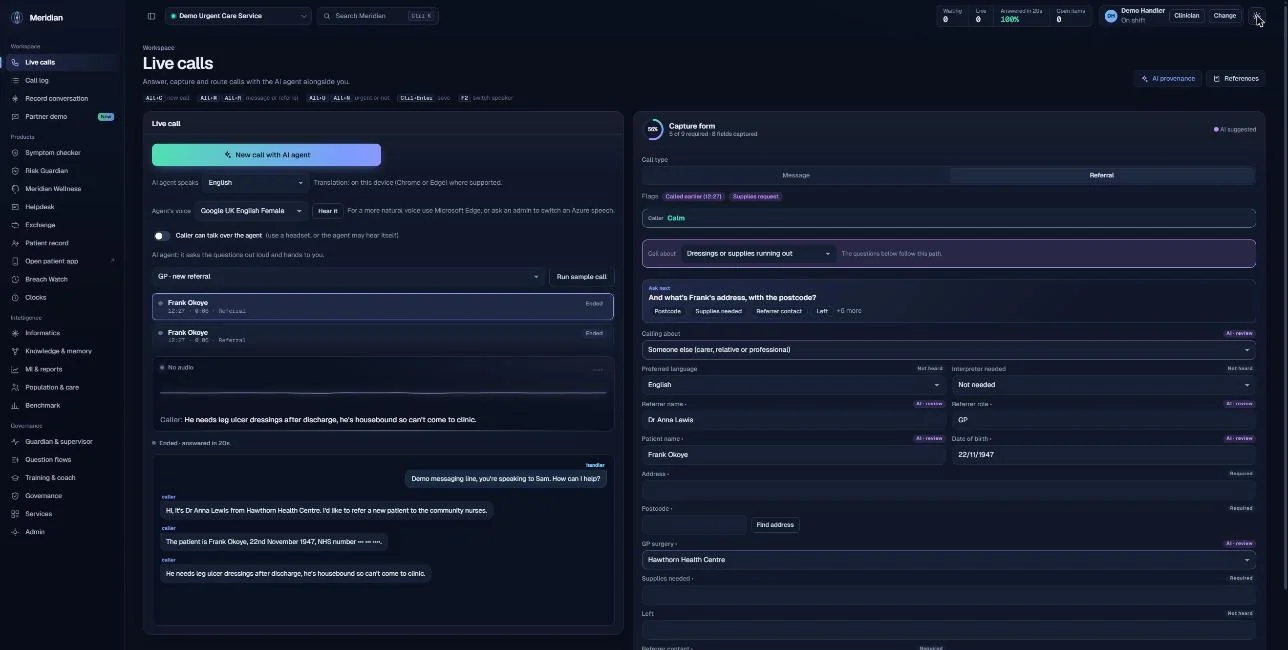
Versioned questions and service configuration guide the conversation. The handler can see what is missing rather than treating a fluent transcript as a complete record.


Voice capture, virtual agent and reviewed handover
Turn a call into structured information that a person can review. Meridian Voice combines configured conversation flows, speech services and AI-assisted capture with explicit human decisions before the next operational step.
Voice is for teams handling repeatable service conversations: message taking, requests, referrals and other scoped call journeys. The service and script define what needs to be collected. A handler can inspect the transcript, review suggested fields and prepare the handover in context. The value is the connection between the conversation and the reviewed work, rather than a claim that a model can independently resolve every request.
Operational call handlers, service owners and technology teams configuring a defined voice workflow. Clinical pathways require their own approved intended purpose and safety evidence; a configurable script is not clinical authorisation.
Versioned questions and service configuration guide the conversation. The handler can see what is missing rather than treating a fluent transcript as a complete record.
Optional telephony and speech adapters support audio and text. Browser demonstrations and a live telephone deployment use different service paths.
Registered model tasks can help interpret conversation content or prepare notes and handovers. Their results remain subject to the configured workflow and human review.
The destination, content and delivery result matter separately. A prepared handover is not proof that a downstream system accepted it.
Select the service, script version, capture fields and permitted destination.
A call or controlled simulation enters the conversation runtime.
Speech, transcript updates and scripted answers contribute to the draft record.
The handler checks the required fields, suggestions and any missing context.
A person initiates the approved next step and checks its delivery status.
Reviewed structured capture, transcript context, a prepared handover and its delivery status. Which artifacts persist depends on the selected save profile, recording choices and destination integration.
The explanation below describes the reviewed implementation and configuration boundaries. It does not assert a completed production deployment.
| Component | Technical mechanism | What to verify |
|---|---|---|
| Application runtime | Voice runs within Meridian’s composed Python ASGI application. Calls, cases, scripts and handoffs share the domain runtime. | These modules are internal application boundaries, not separately deployed microservices. |
| Audio path | Optional Azure Communication Services handles telephone callbacks and media. Azure Speech can supply speech-to-text and text-to-speech. | Browser speech mode may use a browser-vendor service. Approve that path before using identifiable data. |
| Live updates | The console receives WebSocket updates through the runtime event hub. The backplane can coordinate events and presence. | HTTP middleware does not automatically cover WebSocket identity checks; those paths require their own verification. |
| Model tasks | Configured capture, voice, notes and handover tasks pass through the AI gateway. | Some of these tasks deliberately receive identifiable content. Do not assume universal redaction. |
| State and scale | The reviewed ACS configuration requires one active replica because live call/media state resides in process. | Redis coordination does not make a live call survive any restart or establish exactly-once delivery. |
| Persistence | Selected call, transcript and outbox paths use the routed records area; local and cloud storage profiles differ. | Transient call mode can still leave a durable handoff outbox or an independent Helpdesk snapshot. |
Agree recording consent, speech processing, retention, overflow and interrupted-call handling before live use. Test telephony callbacks, transcript failure, unanswered fields and unavailable AI. The supplied review does not establish a tested Azure deployment or a seamless voice continuity plan.
Meridian is a composed modular application. Customer-specific Azure resources, Entra configuration, routed storage and the shared AI gateway form part of the deployment design. Actual role coverage, data flows, provider regions, retention and recovery must be checked in the target environment.
The supplied source review identifies v23.1.0 Helpdesk Plus as its runtime baseline. It records incomplete targeted tests and no live Azure or Graph verification. Read the dated assurance summary before interpreting source capabilities as production readiness.
The implementation includes optional ACS telephony paths. A working production service still needs provisioned resources, approved configuration and exercised integration and continuity tests.
The described journey uses AI-assisted drafts and human review. Autonomous delegation is a separate roadmap discussion, not implied by the voice interface.
The website demo includes a scripted synthetic caller-and-agent sample and tour narration. It is not a live phone connection or a production model response.
Based on the supplied design archive and local v23.1 source baseline. These references identify the reviewed implementation; they are not links to a publicly exposed code repository.