Why every AI agent needs a control layer
The models are ready. Identity, policy, approval and evidence are what decide whether agents reach production.

The agent control platform
Reimea brings agent deployment, governance and controlled AI learning together. Define what agents can access, what they can do and how their knowledge changes—with accountable owners, human review and traceable updates.
Azure & AWS deployment options. Built around your governance.
Illustrative data flows between agents, knowledge and controls.
The cost of getting AI wrong
50%+of GenAI projects abandoned after proof of concept by the end of 2025, according to Gartner.
Gartner identifies weak risk management, unreliable data, rising expenditure and uncertain commercial returns among the reasons projects stop.
Reimea brings those controls into the agent lifecycle: governed deployment, accountable knowledge updates, human review and evidence of what happened.
This is an overall abandonment figure across several causes; Gartner does not attribute the whole percentage to governance alone.
Source: Gartner, 26 January 2026Why now
The question for regulated organisations has moved on from whether to use AI agents. It is now who answers for what an agent did, and whether you can prove it afterwards.
of enterprise software applications are expected to include agentic AI by 2028.
of day-to-day work decisions are expected to be made autonomously by agents by 2028.
of agentic AI projects are expected to be cancelled by the end of 2027, partly because of weak risk controls.
Source: Gartner predictions, June 2025, as reported by SD Times.
The models are not what holds these projects back. What holds them back is identity, policy, approval and evidence. That is the work a CISO, a SIRO or a clinical safety officer has to sign.
Reimea starts there. We build the control layer first, then put agents to work inside it. You can expand what agents do without losing sight of who is accountable.
The control layer
Reimea’s design brings identity, model policy, human approval and evidence together. The reviewed build has task and route coverage to validate before production use.
Identity and access are scoped to the customer environment. The Azure baseline uses Microsoft Entra ID; AWS identity integration is defined for its deployment configuration.
Editions and roles decide which agents and modules each person can use.
Registered tasks use the AI gateway. The reviewed hosted configuration restricts provider selection; region and task coverage need testing.
Agents draft captures, suggestions and answers. People check and decide.
Application audit chains and structured logs support review. Durable storage and coverage need verification.
Controlled AI learning
Give agents a way to use improving knowledge while keeping ownership, approval and publication in human hands. Decide what changes, who reviews it and where the approved version may be used.
Bring source material, operational feedback and corrections into a review process. Treat new information as a proposal until an owner checks it.
Review the wording, evidence, intended audience and service scope. A named person decides whether staged content is ready to publish.
Keep source references, versions and review dates visible. Revised or deprecated content needs a new lifecycle decision before reuse.
Retrieve eligible references for the permitted module and service. People can inspect the evidence behind a suggestion and decide the next action.
Knowledge Control manages the content lifecycle. Meridian Knowledge retrieves relevant passages and makes sources inspectable. The concept graph helps explain how sources, concepts, controls and products connect.
This approach improves the governed knowledge agents can retrieve. Models do not retrain themselves or change their own permissions. Operational feedback still needs an agreed review process; module-specific workflows and deployment checks apply.
Cloud deployment / Azure & AWS
Reimea’s deployment direction covers Microsoft Azure and Amazon Web Services (AWS), giving organisations a choice of cloud environment for their agent control platform.
Agent permissions, governed knowledge, human review and evidence remain the platform’s focus. The selected cloud services, integrations and validation must match the customer’s requirements.
AWS deployment is planned. The current source-reviewed evidence covers the Azure design; cloud-specific release and deployment verification will be agreed for each environment.
How an agent action runs
A call, request or question arrives. The agent captures it against a versioned script.
The agent drafts a capture, suggestion or answer, citing its sources.
Identity, entitlements and model policy are checked at the gateway before anything is used.
A named handler reviews the draft, then accepts, edits or rejects it.
Only then is the handover made, the ticket assigned or the record updated.
Application audit events support review; coverage and durable storage need verification.
A concrete example
Capture the request, inspect an AI draft, review its source and make a human decision. The guided example uses fictional IT service data.
No live calls or model requests. No patient records.
Explore the 90-second walkthrough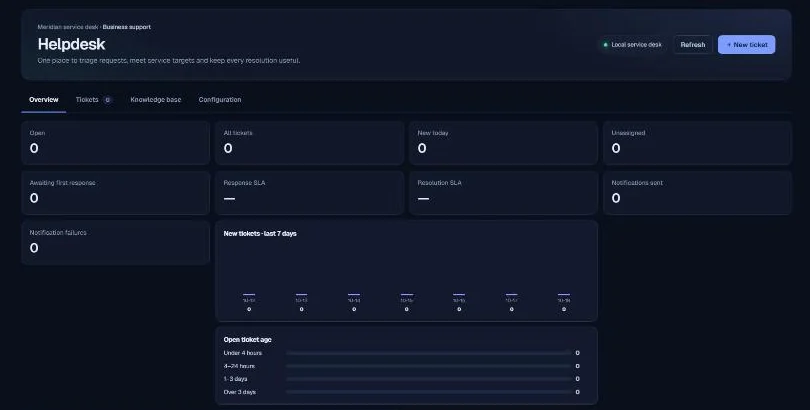
The full Reimea product family
The full Reimea range stays visible below. Knowledge Control has its own functional and technical page too. Clinical and patient-facing experiences remain demonstrators.

Voice and virtual agent
Capture against versioned scripts, review transcripts and prepare a human handover.
Explore Meridian Voice
Understanding human conversations
Follow conversations between people, surface expressed concerns and questions, and show the words behind each signal for human review.
Explore Meridian Listen
Requests, assignment and inventory
Manage requests, service targets and inventory, with AI suggestions reviewed before use.
Explore Meridian Service Desk
Governed sources and retrieval
Manage source ownership, review and publication in Knowledge Studio. Helpdesk articles follow a separate workflow.
Explore Meridian KnowledgeExplore the interactive knowledge graph ↗
Reporting and operational insight
Explore operational data, quality checks, aggregates, forecasts and monitors, with assumptions visible.
Explore Meridian Intelligence
Supervision and quality review
Explore service oversight and human review. Demonstrator risk signals do not establish validated autonomous clinical decisions.
Explore Meridian Guardian
Clinical demonstrator
Explore bounded wellbeing and patient-facing concepts using synthetic data. This is not a validated diagnostic or treatment service.
Explore Meridian Wellness
Source-attributed care records · in development
A separate shared-care-record product design, currently a synthetic demonstrator. A Meridian login never grants Exchange record access.
Explore Reimea ExchangeOwnership, approval and publication
Inspect the governance lifecycle behind eligible knowledge: staging, accountable owners, versioning, review dates and scoped retrieval.
Explore Knowledge ControlThe Meridian suite
Explore the product areas and their shared design. Screens are supplied product examples; clinical and Exchange views remain demonstrators. See the assurance page for validation boundaries.
Assurance
Your assurance team will ask what is built and what is not. Here is the answer, in plain terms.
Reviewed 18 October 2026 against the supplied v23.1 design and security documentation.
Source implementation does not establish production readiness.
Products
Meridian and Exchange share a platform design, with separate access boundaries. A Meridian login does not open an Exchange record.

Voice-led service operations with agents built in: voice and virtual agent, capture and handover, service desk, governed knowledge and operational intelligence, all behind one control layer.
Explore MeridianA shared care record that shows where every item came from, when, and what is missing. The target design uses FHIR R4; only a synthetic demonstrator exists today.
Read the design thinkingThe Reimea vision
Trust in agents is earned in stages. Each stage widens what agents may do on their own, and the same control layer stays underneath.
Agents listen, draft and suggest. A person approves every action before it reaches a system.
Agents act on their own inside a policy boundary you set. People handle the exceptions and review samples.
Agents work across teams and organisations, handing work to each other with provenance and consent intact.
Horizons 2 and 3 describe direction, not shipped features. We will publish each capability with its evidence when it is built.
Who it is for
Reimea is designed for organisations whose buyers include a CISO, a SIRO or a clinical safety officer, and who need to answer to a regulator.
Out-of-hours, urgent care and NHS-commissioned services. Voice capture, reviewed handover and service desks, with intended-use and assurance work scoped before deployment.
Contact centres and operations teams where every decision needs an owner, an audit trail and a model-risk story.
Shared service desks, IT and estates teams that want agents doing the routine work while working inside a customer-specific cloud environment.
Insights
Practical writing for the people who sign off AI in regulated organisations. All insights
The models are ready. Identity, policy, approval and evidence are what decide whether agents reach production.
"Human in the loop" is easy to say. Here is how to design approval that people can sustain and auditors can trust.
A shared record should tell you where each item came from, and what it cannot see. The design thinking behind Reimea Exchange.
Practical guides
Workflow guide
A synthetic workflow example showing capture, source inspection, human review and handover without claiming a customer result.
Read the guideWorkflow guide
A pilot measurement guide covering handling time, completeness, correction, reviewer workload and evidence.
Read the guide
Company
Paul formed Reimea in 2026 to address the need for control and governance as businesses adopt AI.
Paul has more than 25 years of enterprise technology and leadership experience across investment banking, US healthcare AI and cybersecurity, including roles with Rothschild, NASDAQ, Wells Fargo and IBM.
From 2015 to 2023 he built healthcare technology in the US, co-founding HealthPointe Solutions and serving as its CTO and CISO. His background also includes UK healthcare IT, information governance and security leadership. He has sat on the side of the table that has to approve these systems, and Reimea is built for the people who sit there.
Our story and Paul’s background
Questions
It is the set of controls between AI agents and the systems they act on: who the agent acts for, which models it may call, which actions need a person to approve, and a record of everything it did. Reimea Meridian provides that layer for voice, service desk, knowledge and intelligence work.
Agents draft and suggest, and a named person reviews and decides. Registered AI tasks use a shared gateway. Identity and permissions are scoped to the customer environment; the Azure baseline uses Microsoft Entra ID. The reviewed build includes application audit chains; completeness and durable retention need verification.
Deployment options cover Azure and planned AWS. The Azure baseline describes customer-specific resources, including identity, keys, storage and a database. AWS services and identity integration will be defined for its configuration. Agree the hosting region, model processing locations, data flows and retention before deployment.
Registered model tasks use Meridian’s AI gateway. Hosted provider restrictions exist in the reviewed configuration; each task, model SKU and processing region still need deployment verification.
Clinical and patient-facing modules are demonstrators. Production use requires an agreed intended purpose, appropriate safety evidence, security and identity validation, approved connections where relevant, and deployment-owner approval.
Meridian runs voice-led service operations and the agents within them. Exchange is a source-attributed shared care record, currently in development. They are separate products, and a Meridian login never gives access to Exchange records.
Getting started
01 / BRIEFING
A 45-minute discussion with the technology, operational and governance leads who own the decision.
02 / DISCOVERY
Map systems, review points and baseline performance. Define the evidence needed before proceeding.
03 / BOUNDED PILOT
Agree a statement of work, success criteria and a stop/go review. Pricing and timing follow the scope.
A 45-minute briefing for your technology, security and governance leads. We cover the control layer, Azure or AWS deployment planning and an honest view of what is ready.