Reimea

Reimea Meridian / Listening agent

Human conversations. Reviewable understanding.

Meridian Listen

Help the person handling a conversation see what needs attention: the topic, expressed concerns and questions still to address, with the words behind the signals kept visible.

How it works technically

Keep the person in the conversation.

Listen is Meridian’s product for understanding human-to-human conversations. It supports a handler while people talk, helping them notice a repeated concern, a service topic or a question that may still need an answer. The person remains responsible for understanding the context and deciding what to do next.

Use cases include customer-service calls, operational support and authorised healthcare demonstrations. A service owner configures the relevant topics and phrases rather than assuming one vocabulary fits every organisation.

Listen, Voice and Guardian

Voice handles agent-led voice interaction and structured capture. Listen analyses the content of conversations between people. Guardian provides supervision and service oversight. They can work together, but each has a distinct purpose.

The reviewed source exposes Listen as a standalone and integrated product service. A production live-audio path still depends on the configured channel, transcription, identity and deployment controls.

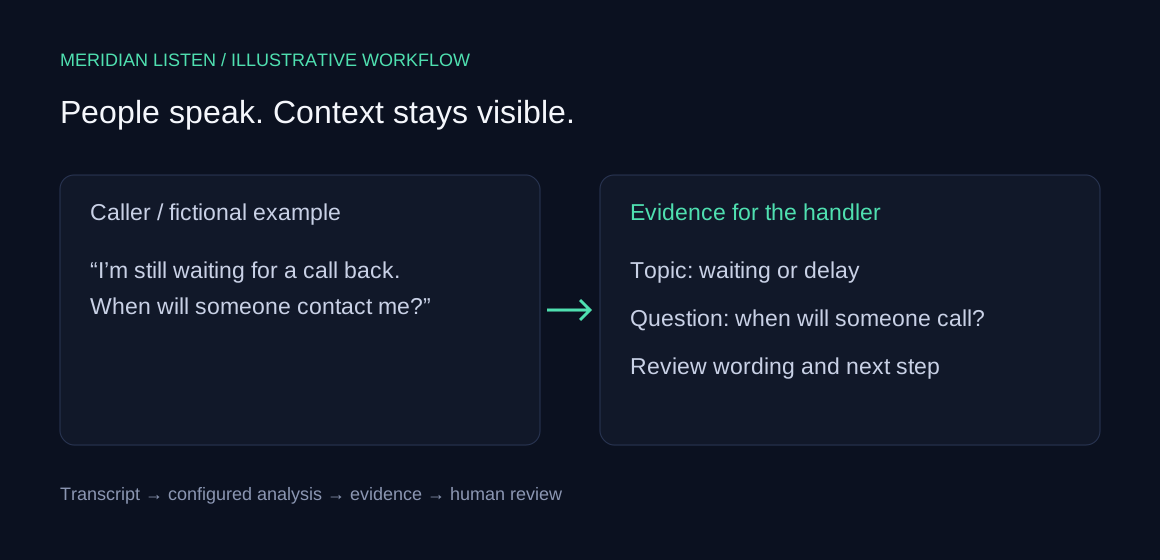
Illustrative flow from a fictional caller’s words to evidence for a handler
Illustrative workflow with fictional wording, not a product screenshot or live analysis.

From transcript to useful context.

Evidence beside signals

Configured phrase matching can surface expressed emotion categories with evidence from the caller’s wording. A label is a prompt to inspect the conversation; it is not a reliable measurement of somebody’s internal emotional state.

Topics suited to the service

Presets cover healthcare, customer service, financial services, utilities, public services and education. Custom topics and phrases allow the service vocabulary to be reviewed before use.

Concerns and questions

The analysis extracts concern-like sentences and candidate open questions. It also checks repetition and a simple change in wording over time, helping the handler choose what to revisit.

Optional model assistance

Where enabled, a model can add permitted topic or emotion tags using evidence quotes. The rules-based path remains available, and the optional tags do not change the calculated level or safety routing.

A person stays responsible at every step.

  1. 01

    Authorise

    Agree the conversation purpose, participants, permissions and recording or transcription arrangements.

  2. 02

    Transcribe

    Receive speaker-labelled text through an agreed channel. Inspect transcription quality and speaker attribution.

  3. 03

    Analyse

    Apply the service listening profile to the selected utterances, with optional bounded model tags when configured.

  4. 04

    Review

    Show topics, evidence, concerns and candidate unanswered questions to the handler. Check them against the conversation.

  5. 05

    Act

    The responsible person clarifies the issue and decides the next step. Any save, handover or escalation needs its own workflow controls.

How Listen analyses a conversation.

The implementation combines configurable, explainable rules with optional model-assisted tags. The following describes the supplied source baseline, with deployment boundaries beside each mechanism.

Reviewed Listen mechanisms and limits
LayerMechanismBoundary
Service boundaryThe Python ListenService delegates semantic analysis to the shared runtime. Product routes accept utterances or text and obtain the service’s listening profile.It runs inside the composed application. A separate product name does not imply an independently isolated microservice.
Speaker-aware inputThe analysis distinguishes caller and handler text. Caller wording drives the surfaced topics and expression signals; handler wording helps the open-question heuristic.Incorrect speaker labels or transcription errors can alter results. Live channel integration requires its own end-to-end validation.
Explainable rulesPhrase lists, limited negation handling, sentence patterns and word counts produce evidence, topics, concerns, repetition and simple wording scores.These are language heuristics. Sarcasm, accent, context and indirect language can produce missed or misleading signals.
Candidate open questionsQuestion patterns identify candidates. A question can be treated as addressed when the handler uses one of its main words.Keyword overlap does not establish that an answer was correct, complete or understood. The handler must check.
Optional model tagsThe voice.semantics task uses a structured schema and configured category IDs. It considers the last four caller utterances, capped at 2,000 characters, and checks evidence against supplied wording.It adds tags without changing the calculated level or safety routing. Review provider, payload and task settings; metadata alone is not proof that a model completed successfully.
Speech and voice signalsThe service reports whether Azure Speech configuration is ready and provides helpers for voice-level and combined signals.Configuration readiness is not a tested live audio connection. Voice or wording scores are not validated psychological, diagnostic or urgency assessments.
Outputs and eventsAnalysis returns semantic fields and speech readiness. The platform transcript route also records a transcript-received conversation event.Event recording does not by itself establish complete audit coverage, immutable retention or authorisation for every deployment.

Configure the service. Inspect the evidence.

Outputs can include topic labels, expression categories with evidence, concern sentences, candidate open questions, repetition, wording scores, a simple trend and a handler tip. These are advisory signals. Listen does not independently determine clinical urgency, diagnose a condition or establish how somebody feels.

Profiles allow monitoring categories to be switched on or off. Semantic analysis also has a global off switch. Before a pilot, review phrase lists, representative language, speaker attribution, missed signals and false positives with the people who will use the output.

Agree transcript access, retention, participant notices and permitted model tasks. The website is an explanation of the product; it does not capture or analyse visitors’ microphone audio. A live pilot needs an authorised deployment and a measured evaluation of the complete audio-to-review workflow.

Questions about the listening agent.

Is Listen an AI voice answering the caller?

Its role is to support understanding of conversations between people. Meridian Voice is the agent-led voice product.

Does it need a language model?

The reviewed semantic analysis has a rules-based path. Optional model assistance adds constrained tags when configured; it is not required for the underlying phrase and question heuristics.

Does it understand every unanswered question?

No. The current heuristic can mistake shared words for an answer or miss indirect questions. It helps a handler review the conversation; it does not certify resolution.

Can it detect clinical risk or emotion accurately?

No validated clinical or psychological assessment is established by this source review. Signals require context and human review, with intended-purpose and release evidence for any clinical use.

Technical source notes

Reviewed 18 October 2026 against the supplied v23.1 source baseline: products/listen/service.py, meridian_runtime/semantics.py, api/product_routes.py and api/platform_routes.py. Source inspection does not establish production readiness.

Read the assurance summary
Explore the full product family

Request a briefing

Tell us what you want to improve. We aim to reply within two working days to arrange a suitable time.

Prefer email? [email protected]. A briefing request does not confirm an appointment.

Preview pilot scorecard · Download CSV