Shared task queue
Combine eligible coordination items from Access, Home and Pathways rather than checking each source separately.

New care-coordination range
 Local product demonstrator
Bring referral gaps, pathway milestones and home-care follow-up into one coordination queue with a visible next action.
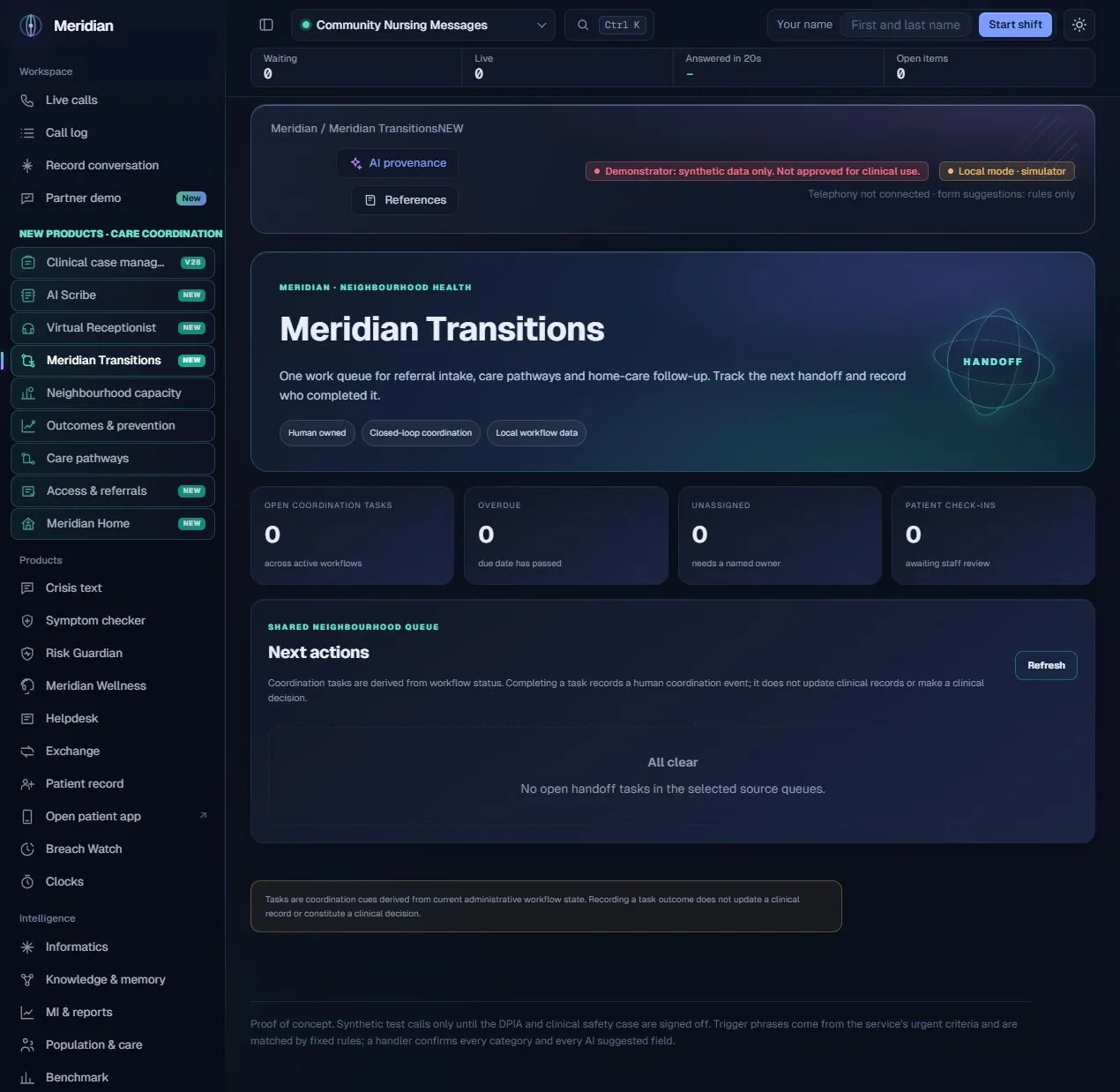
Transitions is for teams managing the work between services. A referral may need more information, an episode may need a planned review, or a patient check-in may need staff follow-up. The workspace collects those coordination cues so a person can assign responsibility and record what happened.
The actual assistance
The current queue is generated by deterministic workflow rules, not a language model. It derives tasks from referral stages, required information, contact dates, active home-care episodes, patient check-in status and open pathway milestones. It can sit alongside AI-assisted intake, but it does not infer a clinical plan, assign urgency or execute an external handoff.
Human ownership
A local coordination demonstrator. Counts depend on the records present in its source stores. A clear queue is not proof that no follow-up is needed elsewhere.
Combine eligible coordination items from Access, Home and Pathways rather than checking each source separately.
Surface referrals that have missing required information and make the outstanding items visible.
Show an action when a referral reaches the ready-for-review stage; acceptance remains a staff decision.
Use recorded next-contact dates to show patient-update work and overdue items.
Bring planned home-care episode reviews into the shared worklist.
Surface check-ins marked as needing contact or unable to complete the plan when staff review is still outstanding.
Show open milestones from active pathways, retaining their subject reference, service and due date.
Record completion, deferral or reassignment with an owner, date and explanatory note.
Review open work, overdue tasks, unassigned items and patient check-ins awaiting staff attention.
Load current Access, Home and Pathways records.
Apply explicit task-generation rules.
Inspect ownership and due-date context.
A person chooses completion, deferral or reassignment.
Save the local coordination outcome for subsequent review.
| Area | Mechanism and scope |
|---|---|
| Derived tasks | The neighbourhood service reads the existing product stores and creates stable task identifiers from source items. |
| Task state | Latest coordination events can change displayed owner or due date; completion events suppress the corresponding queue item. |
| Date handling | Overdue indicators compare recorded due dates with the current date. They do not establish clinical priority. |
| Source boundary | Recording a coordination outcome does not write back to an external clinical record or perform a clinical decision. |
Content checked against the v25.2.0 source and visible local workspace on 30 October 2026. This is a product description and interface inspection, not an end-to-end deployment or clinical validation.
routes/neighbourhood_ops.py, _source_tasks and transitions; RELEASE_NOTES_v24.8.0.md
Review assurance scopeNo. The queue uses administrative workflow state and dates. Clinical assessment and priority remain with authorised people.
No external message or clinical-system update is performed by recording the local event.