Voice and text interaction
Start or stop an assisted conversation, use supported browser speech input or enter a textual answer.

Clinical demonstrator
 Local product demonstrator
Explore a voice-led assisted-assessment conversation with reported symptoms, pathway trace and human-review considerations.
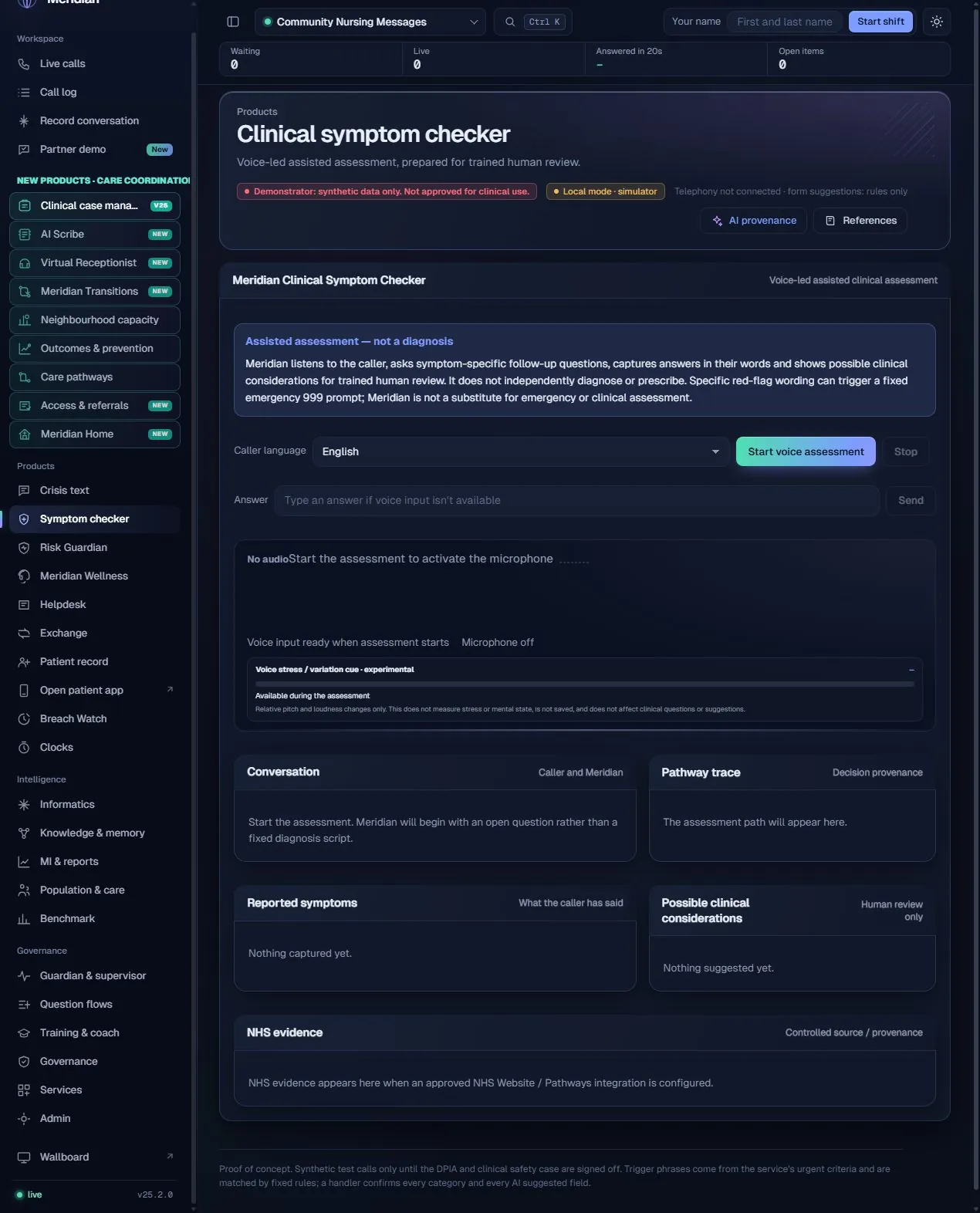
The Symptom Checker demonstration starts with an open conversation, captures the caller’s wording and presents context for trained human review. The interface keeps reported symptoms, the conversation trace, possible considerations and configured evidence sources distinct.
The actual assistance
The configured conversation behaviour can ask follow-up questions and organise reported wording. Possible clinical considerations remain suggestions for trained human review, not a diagnosis or urgency decision. A separate experimental voice-variation cue describes relative pitch/loudness changes; it does not measure mental state, is not saved and does not drive the questions or suggestions.
Human ownership
Synthetic assisted-assessment demonstration only. It does not independently diagnose, prescribe or replace a clinical or emergency assessment.
Start or stop an assisted conversation, use supported browser speech input or enter a textual answer.
Choose a language from the available interface options; actual recognition and translation support depend on the configured services.
Keep caller and Meridian turns visible so the reviewer can inspect the original wording.
Display the information supplied by the caller separately from generated considerations.
Explore symptom-related questions without presenting a fixed diagnosis as the starting assumption.
Show decision provenance so the reviewer can inspect how the conversation progressed.
Display possible considerations with an explicit assisted-assessment boundary.
Show relative voice variation during an assessment without treating it as a stress or clinical measurement.
Reserve a source/provenance area for approved evidence integration; its presence does not establish an NHS integration.
Choose the supported input and language configuration.
Record the caller’s own words.
Retain answers in the visible conversation.
Review reported information and possible considerations separately.
A trained person remains responsible for interpretation and action.
| Area | Mechanism and scope |
|---|---|
| Speech path | Speech support depends on the browser and configured processing services. |
| Conversation context | Caller wording and pathway provenance are presented as inspectable context for a reviewer. |
| Voice variation | The experimental relative acoustic cue is not persisted and is separate from assessment logic. |
| Evidence access | Approved external evidence integrations require their own configuration and release evidence. |
Content checked against the v25.2.0 source and visible local workspace on 30 October 2026. This is a product description and interface inspection, not an end-to-end deployment or clinical validation.
static/clinical-checker.js; meridian_runtime/clinical.py; current workspace inspection
Review assurance scopeNo. It displays experimental relative acoustic variation and is not a validated stress, mental-state or clinical measure.
Not by itself. An approved, configured integration and appropriate verification are required.